Phosphatidylserine Supplements Compared: 8 Options, Honest Evidence
Last reviewed: November 2026. Affiliate links below: as an Amazon Associate we earn from qualifying purchases.
The short version: If you decide to try phosphatidylserine (PS), a single-ingredient product is easier to judge than a blend. Double Wood PS 300 mg is our top pick for a higher dose; Jarrow PS100 is the better starting point because you can adjust 100 mg at a time. The evidence is limited, and FDA calls it “very limited and preliminary.”
PS is a fatty compound found in cell membranes, especially in the brain. Supplements are mostly used by older adults hoping to support memory and by people interested in stress. Be realistic: studies are small and mixed, and results in younger, healthy adults are less clear.
Our top 3
Best overall
Double Wood PhosphatidylSerine Complex 300 mg
300 mg, single ingredient.
Best to start with
Jarrow Formulas PS100 Phosphatidylserine 100 mg
100 mg capsules you can add to.
Best soy-free
Soy-Free Phosphatidylserine from Sunflower (Sharp PS 100)
Sunflower-derived PS softgel.
PS products side by side
| Product | Form | PS amount (per listing) | Best for | |
|---|---|---|---|---|
 Double Wood PhosphatidylSerine Complex 300 mg | Capsule | 300 mg PS per serving | A single-ingredient, higher dose | Check price on Amazon |
 Jarrow Formulas PS100 Phosphatidylserine 100 mg | Capsule | 100 mg per capsule | Starting low and adjusting | Check price on Amazon |
 Brain Supplement Alpha GPC + Phosphatidylserine Complex | Capsule (blend) | PS + Alpha GPC + botanicals | A one-bottle nootropic stack | Check price on Amazon |
 We Like Vitamins Memory Ultimate Complex 1000 mg | Capsule (blend) | 1,000 mg complex incl. PS | Botanicals alongside PS | Check price on Amazon |
 Soy-Free Phosphatidylserine from Sunflower (Sharp PS 100) | Softgel | 100 mg per softgel | Soy-free PS | Check price on Amazon |
 Designs for Health PS 150 Phosphatidylserine | Capsule | 150 mg per capsule | A mid-range dose in one capsule | Check price on Amazon |
 Micro Ingredients Phosphatidylserine 600 mg Complex | Capsule (blend) | 600 mg complex | Long-term stackers | Check price on Amazon |
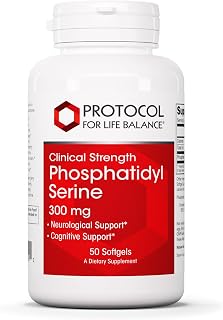 Protocol For Life Balance Phosphatidylserine 300 mg | Softgel | 300 mg per softgel | Egg-free, keto-friendly diets | Check price on Amazon |
Product details come from the Amazon listings and can change. Check the current price, size and label on Amazon before you buy.
How to choose a phosphatidylserine supplement
- Find the actual PS number. A “1,000 mg complex” is not 1,000 mg of PS.
- Pick a dose range first. Cleveland Clinic lists 100 to 200 mg a day as typical. FDA reviewed soy-derived PS as safe up to 500 mg a day.
- Check the source. Today’s PS comes from soy, sunflower or fish, not cow brain. If you avoid soy, buy sunflower.
- Prefer single ingredient. Blends make it hard to know what works, or what is causing a side effect.
- Give it time. Studies usually run for weeks to months, not days.
What does the evidence actually say?
In 2003 FDA allowed a qualified health claim for PS and cognitive dysfunction, with the disclaimer that “very limited and preliminary scientific research suggests that phosphatidylserine may reduce the risk of dementia in the elderly.” Cleveland Clinic notes PS is not approved to treat any condition, though the FDA considers PS from soy, sunflower and fish to be generally recognized as safe. In short: reasonable to discuss with your doctor, but not a proven memory fix.
Each product, reviewed
1. Double Wood PhosphatidylSerine Complex 300 mg
Verdict: Best overall. A single-ingredient capsule at 300 mg per serving, so you know what you are paying for. That is above the 100 to 200 mg a day Cleveland Clinic gives as a typical range, so it suits people whose clinician has suggested a higher amount.
- Listing details: 120 capsules; 300 mg PS per serving; vegetarian capsules per the listing
- Good for: People who want a simple, higher-dose PS without herbal extras.
- Keep in mind: Check how many capsules make a serving; some people prefer softgels.
2. Jarrow Formulas PS100 Phosphatidylserine 100 mg
Verdict: Best for flexible dosing. A 100 mg capsule is a convenient building block: one for a modest amount, two for 200 mg. That makes it the easiest way to stay within the range most references call typical.
- Listing details: 120 capsules; 100 mg per capsule; vegetarian capsules per the listing
- Good for: First-time users and anyone who wants to adjust the dose.
- Keep in mind: Reaching 300 mg means three capsules.
3. Brain Supplement Alpha GPC + Phosphatidylserine Complex
Verdict: Multi-ingredient, less transparent. Combines PS with Alpha GPC and a list of herbs. It is convenient, but if the PS amount is inside a proprietary blend you cannot tell how much you are getting, and you cannot tell which ingredient is doing what.
- Listing details: 60 capsules; PS + Alpha GPC with bacopa, ginkgo, lion's mane, huperzine A and L-theanine per the listing
- Good for: People who specifically want a blended formula.
- Keep in mind: Herbal blends can interact with medicines; huperzine A and ginkgo are worth asking a pharmacist about.
4. We Like Vitamins Memory Ultimate Complex 1000 mg
Verdict: Broad blend, PS amount unclear. A memory-themed blend that includes PS, ginkgo, gotu kola and DMAE. The “1,000 mg” refers to the whole complex, so the PS amount per capsule may be well below the single-ingredient products.
- Listing details: 100 capsules; soy-free per the listing; PS amount per capsule to be read from the label
- Good for: Buyers who want a general memory formula rather than PS on its own.
- Keep in mind: Do not compare its “1,000 mg” to the PS-only products.
5. Soy-Free Phosphatidylserine from Sunflower (Sharp PS 100)
Verdict: Best for soy avoidance. Made from sunflower rather than soy, which matters if you avoid soy. The 100 mg softgel is also easy to dose in steps.
- Listing details: 90 softgels; sunflower-derived PS; 100 mg per softgel per the listing
- Good for: People with soy sensitivity.
- Keep in mind: Softgel excipients vary, so read the other ingredients.
6. Designs for Health PS 150 Phosphatidylserine
Verdict: Good middle option. One capsule sits in the middle of the typical 100 to 200 mg daily range, which is a tidy way to take it once a day. The listing describes sunflower-sourced PS.
- Listing details: 60 capsules; 150 mg PS per capsule; soy-free sunflower source per the listing
- Good for: People who want one capsule a day.
- Keep in mind: A smaller bottle and a higher cost per capsule.
7. Micro Ingredients Phosphatidylserine 600 mg Complex
Verdict: Blend, check the PS amount. A 240-count bottle that adds choline sources and herbal extracts to PS. As with the other blends, the headline milligrams are for the complex, not PS alone.
- Listing details: 240 capsules; listing mentions choline, lion's mane, ginkgo and omega-3; PS amount to be read from the label
- Good for: People who already use several of these ingredients and want to simplify.
- Keep in mind: May be more than you need if you only want PS.
8. Protocol For Life Balance Phosphatidylserine 300 mg
Verdict: Best for dietary restrictions. A 300 mg softgel described as egg-free and keto-friendly. That is a high dose in one softgel, and the 50-count bottle works out to a short supply.
- Listing details: 50 softgels; 300 mg per softgel; egg-free and keto-friendly per the listing
- Good for: People who avoid eggs or follow a keto diet.
- Keep in mind: Not suited to low-dose titration, and the bottle runs out quickly.
Who should skip PS, or ask first
- People taking anticholinergic medicines (for example oxybutynin or benztropine). Cleveland Clinic says PS may reduce how well these work.
- People on blood thinners or other prescriptions who are considering the herbal blends.
- Anyone with soy, egg or fish allergies, who should check the source and capsule.
- Anyone with memory loss that is getting worse. See a doctor; a supplement should not delay a diagnosis.
Side effects
PS is usually well tolerated. Cleveland Clinic lists possible upset stomach, gas, insomnia, headache, skin rash and mood changes, and says higher-than-recommended doses can cause side effects. If it keeps you awake, take it earlier in the day.
Phosphatidylserine questions
How much phosphatidylserine should I take?
Cleveland Clinic gives 100 to 200 mg a day as an average adult range. Some studies used about 300 mg a day. Ask a clinician what is appropriate for you.
Is phosphatidylserine safe?
The FDA considers PS from soy, sunflower and fish generally recognized as safe, and it reviewed soy-derived PS as safe up to 500 mg a day. Safety in pregnancy and with long-term use is less well studied.
Does it help with memory?
The research is small. FDA allowed only a qualified claim with a “very limited and preliminary” disclaimer. Benefits, if any, are more plausible in older adults than in young healthy people.
Does PS lower stress or cortisol?
Some small studies looked at this, but the evidence is not strong enough for us to promise an effect.
Sunflower or soy PS?
Both are used. Pick sunflower if you avoid soy; otherwise the source matters less than the dose and label clarity.
Sources
- Cleveland Clinic: Phosphatidylserine
- FDA GRAS notice 643 (PS from fish) with qualified health claim history
- FDA GRAS notice 636 (PS, 500 mg/day safety discussion)
Medical note: This article is for general information and is not medical advice. Supplements are not approved to treat or prevent any disease. Talk to your doctor or pharmacist before use, especially if you take prescription medicine, are pregnant or breastfeeding, or have memory concerns.
Affiliate disclosure: As an Amazon Associate we earn from qualifying purchases. If you buy through our links we may earn a commission at no extra cost to you. It does not change what we recommend.


