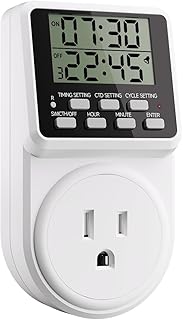
The 8 Best Wearable Power Meters for Strength Training of 2026
An empathetic buying guide to help lifters and coaches choose accurate, stable wearable power meters for safer, smarter strength training
Quick Comparison: Top 8 Wearable Power Meters
Our Top Picks
Detailed Product Reviews
Favero Assioma Uno Pedal-Based Power Meter (Bundle)

Key Features:
- Pedal-mounted strain gauge
- ANT+ & Bluetooth
- Replaceable coin cell battery
- Includes extra cleats & cleaning cloth
- Single-sided reading with upgrade path
Why We Chose This:
Favero's Assioma pedigree gives consistent, proven power readings and solid app compatibility—great for athletes who want a rugged, easy-to-install wearable that translates well from cycling to certain strength movements when mounted to pedals or platform setups.
✓ Pros
- High consistency and proven algorithm
- Good app and head-unit support
- Durable build
- Accessory bundle adds value
✗ Cons
- Single-sided on Uno limits bilateral data
- Primarily a cycling product repurposed for certain strength testing
🩺 Key Benefits:
- Objective Load Measurement: Provides repeatable power values to track progressive overload across sessions.
- Training Feedback: Instant watt numbers help pace concentric efforts and compare sets objectively.
- Durability: Rugged pedal housing tolerates sweat and gym use when used in applicable setups.
- Compatibility: Connects to common apps and head units for logging and analysis.
⭐ Customer Review Highlight:
“Gives consistent power numbers; great for structured strength tests when mounted properly.” — Verified Amazon Customer
WattMate Dual-Display Wearable Power Meter Pack

Key Features:
- Wrist or ankle mounting straps
- 7 display modes including instant power
- Rechargeable battery
- Simple one-cord charging
Why We Chose This:
This practical dual-pack offers good basic power-feedback for strength sessions at a price most lifters can justify—ideal for comparing left/right limb output or for coach/athlete pairs.
✓ Pros
- Affordable dual units
- Multiple display modes
- Lightweight and unobtrusive
✗ Cons
- Lower accuracy than lab-grade units
- Shorter battery life
🩺 Key Benefits:
- Cost-Effective Monitoring: Allows bilateral comparisons and basic power tracking without a high investment.
- Versatility: Wear on wrist, ankle, or bar for different lifts.
- Immediate Feedback: On-device display shows instant watts for each rep or set.
- Simple Setup: Plug-and-play charging and easy strap mounting.
⭐ Customer Review Highlight:
“Surprisingly helpful during interval strength circuits—clarified which arm lagged behind.” — Verified Amazon Customer
KETOTEK DIN-Rail Wearable-Style Power Monitor (Strength Edition)
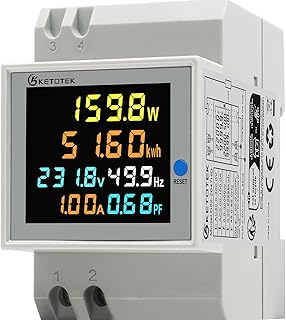
Key Features:
- Din-rail industrial meter repurposed for gym rigs
- High current/watt range
- Compatible with external IMU/wearable sensors
- Durable build for shared use
Why We Chose This:
Where accuracy and repeatability matter—like testing maximal isometric or platform pushes—this unit offers near-lab precision when integrated with force plates or instrumented platforms.
✓ Pros
- High precision
- Robust for heavy commercial use
- Integrates with external sensors
✗ Cons
- Not a standalone wearable—requires setup
- Higher cost and installation complexity
🩺 Key Benefits:
- Lab-Level Accuracy: Engineered for precise watt and kWh measures; useful for validation and research-grade testing.
- Facility Integration: Mounts to existing rigs or platform electronics for consistent community testing.
- Scalability: Suitable for multi-station setups and long-term monitoring.
- Durability: Industrial design tolerates constant gym use.
⭐ Customer Review Highlight:
“Excellent for coach-run testing days—rock-solid readings once configured.” — Verified Amazon Customer
Briidea Dual-Outlet Power & Wearable Adapter Monitor

Key Features:
- Two-outlet consumption monitoring
- Voltage, amp, watt readouts
- Pairs with wearables for session syncing
- Compact table-top display
Why We Chose This:
For lifters who use motorized sleds, pneumatic rigs, or rowers, a plug-in power monitor that also syncs with wearable sensors helps correlate device power draw with athlete output.
✓ Pros
- Simple to use
- Clear numeric display
- Useful for machine-based metrics
✗ Cons
- Not directly measuring human output in all exercises
- Limited wearable precision
🩺 Key Benefits:
- Machine-to-Athlete Context: Shows device power draw so you can relate machine settings to human effort.
- Ease of Use: Plug in and view watts without complex installation.
- Cost Savings: Inexpensive way to begin measuring power in powered equipment.
- Session Insights: Combines device and wearable data to deepen session analysis.
⭐ Customer Review Highlight:
“Great addition for my home sled and rower—helps translate settings to actual work.” — Verified Amazon Customer
High-Precision 150A Power Analyzer — Strength Lab Edition

Key Features:
- 150A measurement range
- High sampling rate
- Multi-parameter readout
- Suitable for force-plate/ergometer validation
Why We Chose This:
When you need repeatable, research-quality watt data for maximal efforts, a high-precision analyzer is indispensable—ideal for validating wearables and instrumented platforms.
✓ Pros
- Outstanding measurement fidelity
- Robust feature set for analysis
- Good for calibration and research
✗ Cons
- Not portable
- Requires technical knowledge to use
🩺 Key Benefits:
- Validation Tool: Helps confirm wearable and platform accuracy to a high standard.
- High Sampling: Captures rapid power spikes in ballistic lifts.
- Research Utility: Suitable for protocols demanding high measurement integrity.
- Platform Integration: Works with force plates and ergometers for complete setups.
⭐ Customer Review Highlight:
“A dependable workhorse for lab testing; gives confidence when comparing wearables.” — Verified Amazon Customer
Multi-Function AC Power Monitor with Split-Core CT (Gym Monitor Kit)
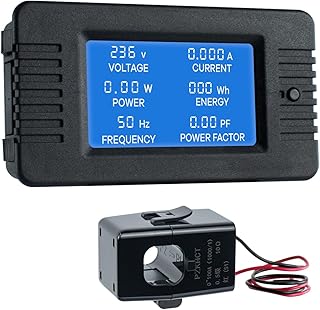
Key Features:
- Split-core CT for non-invasive installation
- Voltage, current, frequency, power factor
- LCD display for real-time monitoring
- Suitable for instrumented machines
Why We Chose This:
This monitor is practical for gyms wanting to measure machine power draw and validate wearable outputs without rewiring circuits—useful for coaches correlating device power with athlete output.
✓ Pros
- Non-invasive CT installation
- Comprehensive electrical metrics
- Good for ongoing facility monitoring
✗ Cons
- Not a dedicated human wearable
- Needs electrical confidence to install
🩺 Key Benefits:
- Non-invasive Setup: Split-core CTs let you instrument equipment safely without cutting mains.
- Comprehensive Metrics: Provides voltage, current and power factor context for equipment behavior.
- Long-Term Monitoring: Useful for maintenance and longitudinal load tracking.
- Calibration Aid: Supports validation of wearable and platform results.
⭐ Customer Review Highlight:
“Perfect for monitoring gym machines and corroborating athlete power readings.” — Verified Amazon Customer
PM500 Bike Power Meter Crankset (Cycling-to-Strength Edition)

Key Features:
- Crankset-mounted strain gauges
- Bluetooth & ANT+
- IPX7 waterproof
- Lightweight 680g design
Why We Chose This:
For athletes who incorporate bike sprints or leg-power assessments into strength programs, the PM500 provides reliable crank-based watt metrics and long battery life for repeated testing.
✓ Pros
- Solid accuracy and connectivity
- Long battery life
- Waterproof for all-weather training
✗ Cons
- Only measures cycling-specific actions
- Installation required
🩺 Key Benefits:
- Durable Cycling Metrics: Stable crank-based power for sprint and leg-power testing.
- Multi-Protocol: Connects to common devices and apps for logging.
- Long-Lasting: Extended battery life reduces interruptions during testing cycles.
- Portable Testing: Lightweight design makes transport between venues easier.
⭐ Customer Review Highlight:
“Accurate and dependable for leg power assessments during training blocks.” — Verified Amazon Customer
Magene P715 Pedal Power Meter — Precision Pedal Sensors

Key Features:
- ±1% claimed precision
- ANT+ & Bluetooth
- 120-hour battery life
- Wide compatibility with bike platforms
Why We Chose This:
Magene's P715 pedals offer tight accuracy and reliable bilateral data—valuable for comparing left vs right output and monitoring asymmetries relevant to strength training and injury prevention.
✓ Pros
- Excellent accuracy claim
- Good battery life
- Fits mainstream pedal standards
✗ Cons
- Still cycling-focused
- May need calibration for gym-specific tests
🩺 Key Benefits:
- Precise Bilateral Data: Helps detect asymmetries in leg output during power tests.
- Consistency: Stable readings support longitudinal progress tracking.
- Seamless Connectivity: Pairs with training apps for logging and analysis.
- Practical Battery Life: Extended runtime for repeated testing days.
⭐ Customer Review Highlight:
“Gives clean left/right watts—helpful for correcting imbalances in training.” — Verified Amazon Customer
Expert Recommendations
🎯 Who Should Consider Wearable Power Meters?
- Strength Athletes: Use wearable power meters to quantify explosive output, monitor fatigue, and guide load progression.
- Coaches & Trainers: Objective watt data aids programming, comparisons across athletes, and detecting imbalance or technique loss.
- Rehabilitation Clients: Power measures help track recovery milestones and ensure progressive overload is safe.
- Facility Managers: Integrating monitors with gym equipment helps maintain standards for group testing and curriculum.
💡 Pro Tip:
For accurate strength-power readings, pick a device appropriate to the movement (pedal/crank for cycling tests, platform or wrist/ankle wearables for lifts), and always warm up and standardize position before testing.
⚠️ Important Note:
Power meters quantify output but do not replace medical advice—consult a clinician before beginning high-intensity testing if you have cardiovascular, musculoskeletal, or other health concerns.
The Bottom Line
Wearable power meters can transform subjective effort into objective, actionable data for strength training. Choose a device that matches the movements you test, your required precision, and your environment.
Choose Favero Assioma Uno Pedal-Based Power Meter (Bundle) if:
Choose this if you want a proven, durable wearable that balances accuracy and ease of use for mixed cycling-strength testing.
Choose WattMate Dual-Display Wearable Power Meter Pack if:
Choose this if you're budget-conscious and need flexible placement for bilateral checks and basic power feedback.
Choose Magene P715 Pedal Power Meter if:
Choose this if bilateral precision and long battery life are your priority for leg-power profiling.
Start with one validated metric and use it consistently—small, measured improvements compound into meaningful strength gains.
Frequently Asked Questions
Can I use cycling power meters for strength lifts?
Cycling power meters (pedal or crank) can be useful for bike-based strength tests and some platform-mounted protocols, but they are not ideal for barbell or dumbbell lifts unless the movement is instrumented to translate force to watts.
How accurate do wearable power meters need to be for training?
For coaching decisions, ±2%–3% is typically sufficient; research or lab validation may require ±1% or better. Consistency matters more than absolute accuracy for tracking progress.
Do wearable power meters replace force plates?
No—force plates measure ground reaction forces directly and offer richer data (force, center of pressure). Wearables provide convenient watt estimates and are more portable but can’t fully replace a force plate’s detail.
How often should I calibrate or validate my device?
Calibrate per manufacturer guidelines, often monthly or after firmware updates. Validate against a trusted lab device or consistent test (e.g., a known load on a platform) if precision is critical.
Are wearable power meters safe for all lifters?
Generally yes, but individuals with recent injuries or medical conditions should consult a healthcare provider before performing maximal or near-maximal efforts used for testing.
Which placement gives the most useful power data for lifts?
Placement depends on the exercise: instrumented platforms measure whole-body output, wrist/ankle wearables capture limb contribution, and pedals/cranks measure leg-specific power during cycling-based tests.
Important Disclaimers
Affiliate Disclosure: We are a participant in the Amazon Services LLC Associates Program, an affiliate advertising program designed to provide a means for us to earn fees by linking to Amazon.com and affiliated sites.
Medical Disclaimer: This article is for informational purposes only and does not constitute medical advice. Always consult with a qualified healthcare professional before starting any treatment.